As additive manufacturing pushes deeper into regulated, high-value production, the industry’s biggest bottleneck is shifting. It’s no longer just “Can we print the part?” It’s, “Can we prove stability, traceability, and capability at scale — without burying QA teams in manual reporting?”
Harry Kleijnen of Additive Center, who has worked alongside Melotte on full-process data capture initiatives, believes AM is now entering the phase where digital quality management becomes core production infrastructure, not optional tooling. “Data driven is only possible when you have deep insights in what your process actually is capable of,” Kleijnen says, pointing to the demands of regulated supply chains where quality evidence must be repeatable and defensible.
Kleijnen’s perspective is grounded in day-to-day production reality — data scattered across machine logs, powder records, post-processing documents, inspection files, and spreadsheets. In that environment, the first stage of any non-conformity response isn’t root-cause analysis, it’s reconstruction. “For the regulated industries, if you need to provide an audit trail, you will do this manually. It takes a lot of time,” he says. The goal, he argues, is to reach a point where it becomes “press on the button to get a complete audit trail of your products.”
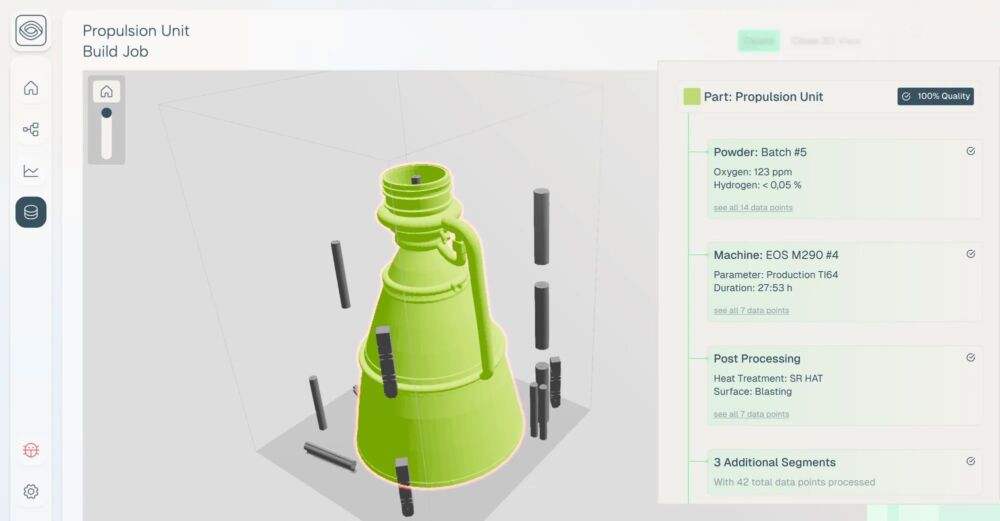
That is precisely where amsight comes in. According to Kleijnen, amsight stands out because it is purpose-built to connect the entire AM process chain, linking powder, process and quality outcomes into a usable digital backbone, rather than leaving teams to assemble proof from disconnected files. “It immediately starts as time saving on reporting and analysis,” he says, adding that the early impact is felt in faster reporting cycles, clearer visibility of drift, and fewer “Excel heroics” when customers or auditors ask questions.
Crucially for OEMs, Kleijnen draws a sharp line between collecting data and controlling processes: “Monitoring data alone isn’t process control. What matters is being able to connect process variation and critical-to-quality factors to product outcomes, building the foundation for process maturity and, ultimately, SPC-driven stability” he says.
For machine OEMs and partners, Kleijnen adds that as end users begin working with “solid” connected data, expectations rise across the supply chain. Manufacturers will identify not only process issues, but also equipment performance issues, pushing the ecosystem toward higher transparency and capability.
His conclusion is blunt, production AM doesn’t need more spreadsheets. It needs a digital quality backbone that makes evidence repeatable and improvement systematic, and amsight is designed to be that backbone.
For manufacturers who recognise themselves in this challenge, Kleijnen’s message is simple. “data is now the route to reliability, and reliability is the route to scale.”

Senior AM Consultant, associated with Additive Center
Harry Kleijnen is a Senior Additive Manufacturing consultant and owner of his own consultancy business, Kiamco. In this context, he is associated with Additive Center. He brings more than 20 years of hands-on experience in industrial AM, covering AM process and application development, large-scale industrialization, and quality assurance for critical applications in semiconductor, medical, and high-tech industries