
How micro 3D printing de-risks micro molding programs before the big tooling decisions
Brett Saddoris, Technical Marketing Manager, Accumold

Brett Saddoris is Technical Marketing Manager at Accumold. The company has grown to a 130,000 square foot fortified facility designed for assurance of supply, employs over 350 staff, and is a net exporter shipping all over the world every day from its Ankeny, IA, USA facility which runs 24 hours a day, 7 days a week.
In micro molding, the most expensive mistakes aren’t always the dramatic ones. They’re the quiet ones: a feature that seems reasonable in CAD but won’t fill reliably; a tolerance stack that only becomes painful when parts are assembled at volume; an interface that looks perfect on a drawing but turns fragile once real handling and packaging enter the equation. And for OEMs (especially in medical, optics, and electronics) those mistakes don’t just cost money. They cost time, internal credibility, and momentum.
That’s why one of the most valuable shifts in micro manufacturing today is happening before tooling ever begins. At Accumold, we increasingly talk about “design freedom before steel.” It’s the idea that the best moment to explore geometry, validate assumptions, and prove manufacturability is while decisions are still reversible. Once hardened tooling starts, your options narrow quickly. Change becomes slower, more expensive, and harder to justify, particularly when you’re trying to manage internal stakeholders who need a clear business case for every step.
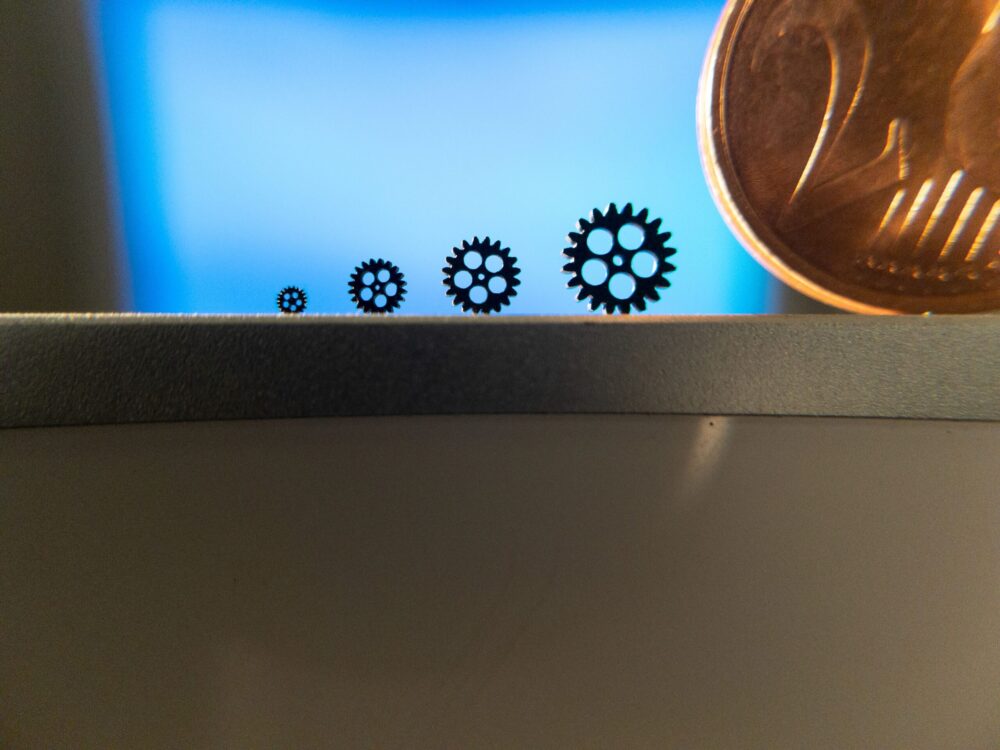
Micro 3D printing is making that early-stage freedom practical. Not as a replacement for micro injection molding, but as a way to reduce risk and make better decisions before you commit significant capital spend and lock timelines.
WHY “BEFORE STEEL” MATTERS MORE AT MICRO SCALE
Every manufacturing engineer understands the principle that the earlier you learn, the cheaper the learning is. Micro molding just turns that dial up to 11.
When parts are tiny, the process window can be narrow. Features that are easy to make at macro scale become sensitive at micro scale. Even small geometry changes (an edge radius, a draft choice, a wall transition) can determine whether a part fills, whether it ejects cleanly, and whether it remains dimensionally stable over time.
Then there’s the human factor inside OEMs. Many micro molding programs don’t die because the idea is bad. They die because the internal organization can’t justify the risk. Tooling cost, qualification burden, and time-to-market pressure all sit under scrutiny. Your procurement team wants certainty. Your program manager wants dates they can stand behind. Your leadership wants a defensible ROI narrative. If your engineering story is “we’ll know once the tool is cut,” you’re asking everyone to accept uncertainty at the most expensive point in the process.
Design freedom before steel gives you a better story, one grounded in evidence rather than hope.
WHAT MICRO 3D PRINTING REALLY DOES IN MICRO MOLDING PROGRAMS
The most useful way to think about micro 3D printing is as a decision accelerator. It brings physical feedback earlier, at the moment when it can actually influence outcomes. In practical terms, it helps OEMs do four things before they commit to hardened tooling.
Validate geometry and interfaces. A CAD model can lie to you. A physical part doesn’t. Printed micro prototypes allow teams to check fits, mating conditions, assembly intent, and even handling and packaging assumptions. For microfluidic devices, that can mean validating channel geometry and sealing concepts. For wearable patches and drug delivery devices, it can mean checking how components locate, snap, or actuate.
De-risk manufacturability conversations. Even when a design is theoretically moldable, the question is whether it’s moldable repeatably, and whether the resulting part will behave predictably in the assembly and use environment. Micro printed parts can support earlier DfM/DfMM discussions with a tangible reference, helping teams identify where risk is concentrated and where design changes yield outsized benefits.
Confirm material choice sooner. Where possible, micro 3D printing can be used to quickly fabricate prototype tooling. Printed tooling allows development teams to evaluate molded parts earlier in their project timeline. Molded parts from printed tooling can be used to confirm the thermoplastic will survive downstream operations, exhibit desired material properties, and perform as designed in their final assembly.
Support parallel path planning. One of the underrated benefits is timeline compression. Customers can begin early work on fixtures, inspection concepts, and assembly process planning using printed parts while tooling is underway. That doesn’t eliminate the need for final validation on molded parts, but it reduces idle time and makes project timelines more resilient.
WHY MULTI-PLATFORM MICRO 3D PRINTING MATTERS
Not all micro 3D printing technologies behave the same way. Resolution, surface finish, throughput, build envelope, and material options vary widely. If you only have one platform, you tend to push every project through the same funnel, whether it’s the best fit or not.
A multi-platform approach such as the one at Accumold gives customers something far more valuable, process choice aligned to purpose. Sometimes you need the finest feature fidelity to validate micro details. Sometimes you need smoother surfaces for optical-like interfaces or better fit behavior. Sometimes you need enough parts for early testing or pilot workflows. Sometimes speed matters most.
The best early-stage programs treat prototyping as a series of questions, each requiring a different kind of evidence. Multiple micro printing platforms allow those questions to be answered efficiently, without forcing compromises that can muddy the very learning you’re trying to capture.
SPENDING MONEY WITH CONFIDENCE
For OEMs, this “before steel” approach changes the internal pitch. Instead of requesting tooling spend with uncertainty, teams can bring forward:
- Physical prototypes that demonstrate fit and interface intent
- Early risk identification and mitigation plans based on real parts
- Clearer CTQs (critical-to-quality features) informed by practical evaluation
- Evidence that timelines are realistic because parallel tasks can begin sooner
- A stronger basis for supplier selection because capability is demonstrated, not claimed
This matters because micro molding is often strategic but expensive. It’s a high-leverage process. Get it right, and you unlock scalable, repeatable production of extremely complex parts. Get it wrong, and you can burn months in redesign loops and tool rework.
Micro 3D printing reduces that risk by shifting the learning earlier, when it’s cheaper and faster to act on it.
BRIDGING THE GAP FOR LOW VOLUMES AND UNCERTAIN DEMAND
Not every project is ready for tooling. Some programs need limited parts for clinical evaluation, early market testing, engineering validation, or stakeholder demonstrations. In those cases, micro 3D printing can provide a practical bridge, parts that allow progress without forcing premature investment.
That “bridge supply” capability also protects decision quality. It lets teams test assumptions and build confidence while demand is still uncertain. And when the moment comes to move into molding, the design is often better prepared, because it has been informed by real-world interaction rather than purely theoretical planning.
THE LEADERSHIP POINT
A good micro molding partner isn’t one who says “yes” to every design. It’s one that helps you discover what’s true early enough to matter. In this sense, micro 3D printing services aren’t just another offering. They are part of a broader manufacturing philosophy, reducing risk before it becomes expensive, making learning tangible, and helping customers commit to tooling with confidence.
At Accumold, we view this as a natural evolution of what micro manufacturing needs. The market is asking for smaller parts, faster cycles, and higher certainty. The only way to meet those demands is to make early-stage development more evidence-driven, so by the time steel is cut, the program is already on stable ground.
CONCLUSION
Tooling will always be a major milestone in micro molding. But it shouldn’t be the moment when learning begins. The smartest programs start learning earlier, when options are still open, when design freedom is real, and when internal stakeholders can say “yes” based on evidence rather than optimism.
That’s the promise of design freedom before steel. Faster decisions, fewer surprises, and a clearer path from concept to scalable production, especially for OEMs who must justify capital spend and timelines with confidence.